Opensea OS2 NFT and Token Trading
Opensea combines NFT purchases, sales and creation with cryptocurrency swaps in its OS2 marketplace. NFTs, or non-fungible tokens, identify distinct on-chain items; fungible tokens represent interchangeable units. The interface connects these activities across supported blockchains, with different payment methods and settlement rules. Choosing an existing listing, a token swap or a mint changes the asset you receive and the costs involved.
A collection page helps compare particular items and existing offers. A token page deals with amounts, liquidity and trading quotes. Wallet access, the asset's blockchain and the chosen transaction determine which features and costs apply.
NFT collections and token liquidity in OS2
OS2 combines collection discovery with token trading, bringing item listings and exchange liquidity into the same interface while retaining their different ownership and pricing models. The rebuilt marketplace left beta in May 2025. Its collection tools include trait filters, sale activity and aggregated marketplace listings. A collection's floor price describes its lowest listed asking price in the selected view. That figure does not establish what every item can sell for.
Token swaps draw on third-party routing and liquidity services. Liquidity means the funds available to complete an exchange. Available routes and trade size influence the quoted output. Portfolio views show holdings, while activity records track listings, offers and completed trades.
Token identity, editions and ownership
An NFT's identity comes from its blockchain record. For EVM NFTs, the contract address and token identifier are more useful than an image or collection name when distinguishing similar-looking items. On Ethereum, ERC-721 tracks individually identified tokens. ERC-1155 also supports token types with multiple copies, so an edition can have several holders. The quantity offered matters when a listing covers copies of the same item.
Media and metadata describe the token, and their storage and update rules depend on the collection. An ownership record alone does not establish permanent image storage or unrestricted commercial rights. The creator's applicable license governs permitted uses of the artwork. Buying a token and acquiring copyright are separate matters, even when a collection advertises benefits for holders.
Wallet sign-in and blockchain compatibility
Opensea supports existing-wallet access and email-based wallet creation, with compatibility determined by the blockchain and the feature being used. Email login creates self-custodial wallets. Linking other wallets groups their views under an account without merging their balances.
Ethereum and other Ethereum Virtual Machine (EVM) networks use a different address system from Solana. A Solana NFT requires a Solana-compatible wallet. Support for token swaps on a network does not establish support for NFT creation there. Studio's creation tools target supported EVM networks; Solana NFT trading has its own requirements.
Email login wallets can pay network fees with supported stablecoins on supported chains through account abstraction. This mechanism lets a smart account bundle actions and use alternative gas-payment arrangements. The feature requires a delegation on each supported chain, included in its first bundled transaction. External wallet connections cannot use this payment option.
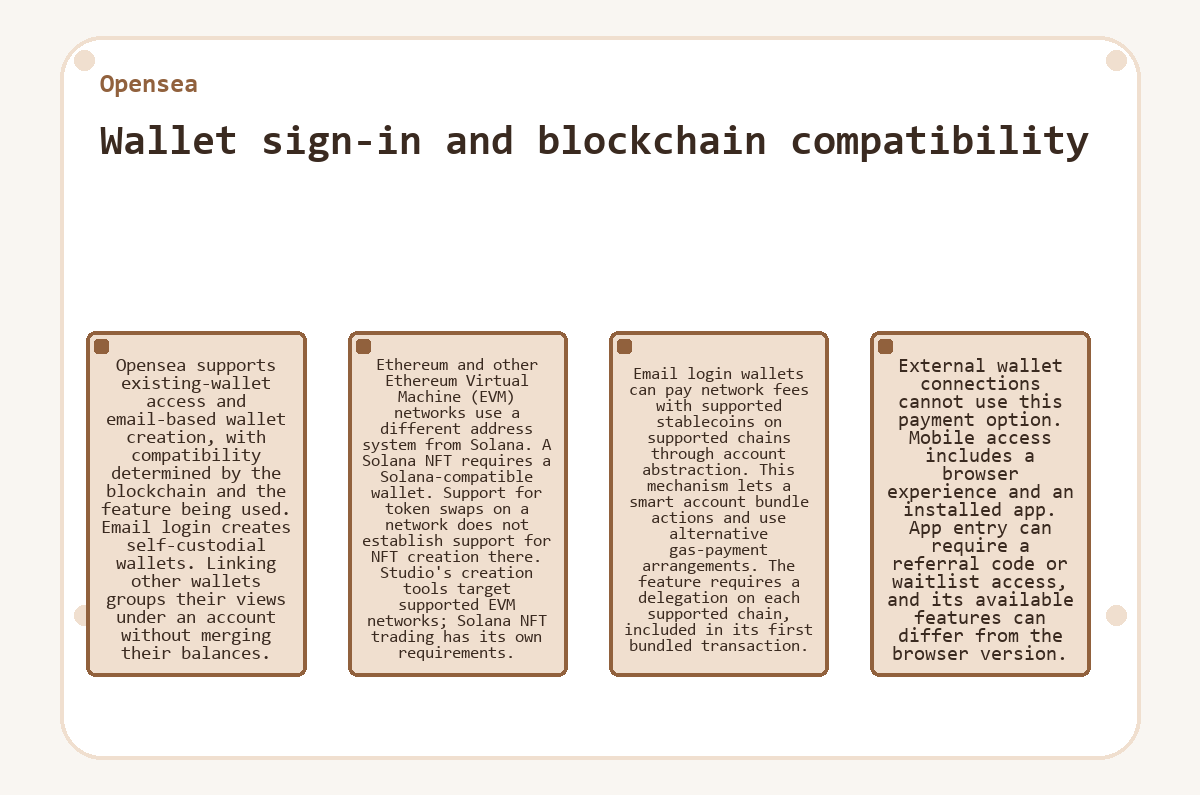
Mobile access includes a browser experience and an installed app. App entry can require a referral code or waitlist access, and its available features can differ from the browser version.
Listings, offers and Studio creation
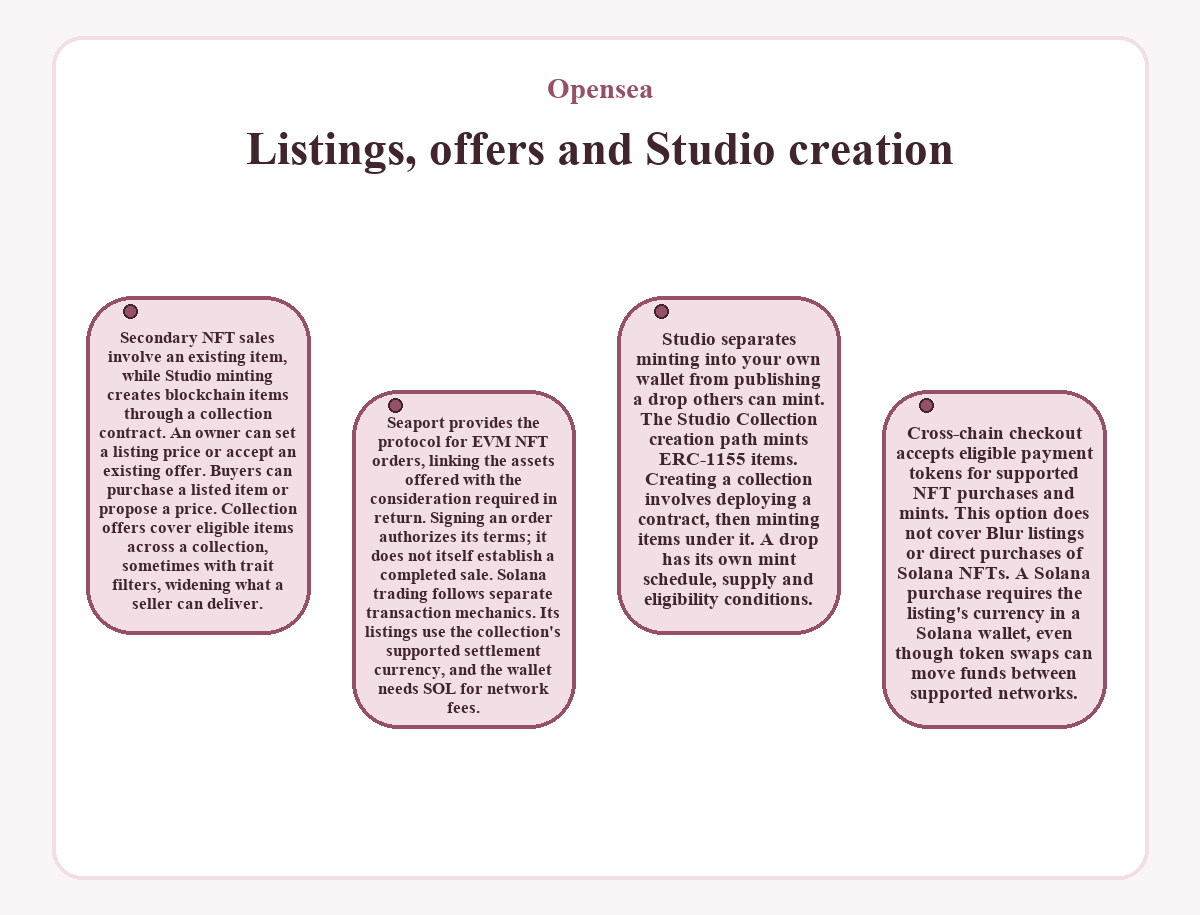
Secondary NFT sales involve an existing item, while Studio minting creates blockchain items through a collection contract. An owner can set a listing price or accept an existing offer. Buyers can purchase a listed item or propose a price. Collection offers cover eligible items across a collection, sometimes with trait filters, widening what a seller can deliver.
Seaport provides the protocol for EVM NFT orders, linking the assets offered with the consideration required in return. Signing an order authorizes its terms; it does not itself establish a completed sale. Solana trading follows separate transaction mechanics. Its listings use the collection's supported settlement currency, and the wallet needs SOL for network fees.
Studio separates minting into your own wallet from publishing a drop others can mint. The Studio Collection creation path mints ERC-1155 items. Creating a collection involves deploying a contract, then minting items under it. A drop has its own mint schedule, supply and eligibility conditions.
Cross-chain checkout accepts eligible payment tokens for supported NFT purchases and mints. This option does not cover Blur listings or direct purchases of Solana NFTs. A Solana purchase requires the listing's currency in a Solana wallet, even though token swaps can move funds between supported networks.
What determines the cost of a trade?
An NFT purchase costs the displayed item price plus network charges and any creator earnings charged separately; a token swap has route-specific fees and gas. Secondary-sale prices shown to buyers include the platform fee. For listings and offers created on Opensea, that fee is set at creation, while primary drops can follow different terms. The transaction breakdown shows the actual charges for the selected action.
Blockchain gas fees cover transaction processing on the network. Network demand and the transaction's required computation affect this cost. EVM collection approvals can incur gas before later listings, while purchasing, minting and accepting offers require settlement transactions. Solana listings and offers involve network fees plus a refundable account deposit. A gas-free signature does not make every associated action free.
Creator earnings, often called royalties, are payments to the NFT's creator. On EVM sales, they come from the item price. Buyers of Solana listings pay them on top; accepted Solana offers deduct them and the platform fee from the offered amount. Collection settings and enforcement determine whether payment is compulsory or optional. Swap quotes can also carry provider charges. EVM swap exchange rates account for fees; Solana swap fees are additive. Neither exchange rate includes gas.
Same-chain and cross-chain swap choices
A same-chain swap changes the token balance on one network, while a cross-chain swap also changes where the receiving balance becomes available. If the intended token exists on several supported networks, comparing destination choices can reveal different routes and costs. Keep this comparison at the quote stage, before authorizing or submitting the swap.
Slippage tolerance limits acceptable price movement before execution. Swap impact describes the trade's expected effect on pool prices. A larger tolerance permits a worse execution price.
- Keep the sending token and amount unchanged when comparing supported destination options.
- Confirm each receiving token's identity and blockchain, including the compatible recipient address.
- Confirm the starting wallet can cover gas through an available payment method.
- Compare quoted output, gas, provider charges and estimated completion time for both routes.
- If the destination is wrong, correct that selection and obtain a fresh quote before signing.
- Authorize submission only after the intended destination and acceptable trading conditions match the quote.
Reviewing an unsigned quote does not submit a swap. Previous approval transactions may already have incurred gas. After submission, a transaction identifier lets you track progress; completion requires successful settlement and receipt of the selected token. A cross-chain transfer's outgoing transaction alone does not establish receipt on the destination network.
Perpetual positions through Hyperliquid
Eligible users can access Hyperliquid perpetual markets through Opensea, adding derivative positions alongside NFT ownership and spot-token balances. Perpetual trading may not be available to every user and excludes users in the United States, United Kingdom and US-sanctioned countries. A perpetual position gives price exposure without ownership of the underlying asset. It has no fixed expiry and remains open until closed or liquidated. The integration uses USDC collateral, and Hyperliquid maintains the underlying positions.
Margin is the collateral supporting a position. The interface uses isolated margin, assigning collateral to each position separately. Leverage increases exposure and liquidation risk. Funding payments and trading fees affect the position's cost over time. Opensea displays the same underlying Hyperliquid positions when you connect the same wallet.
Collection authenticity and contract permissions
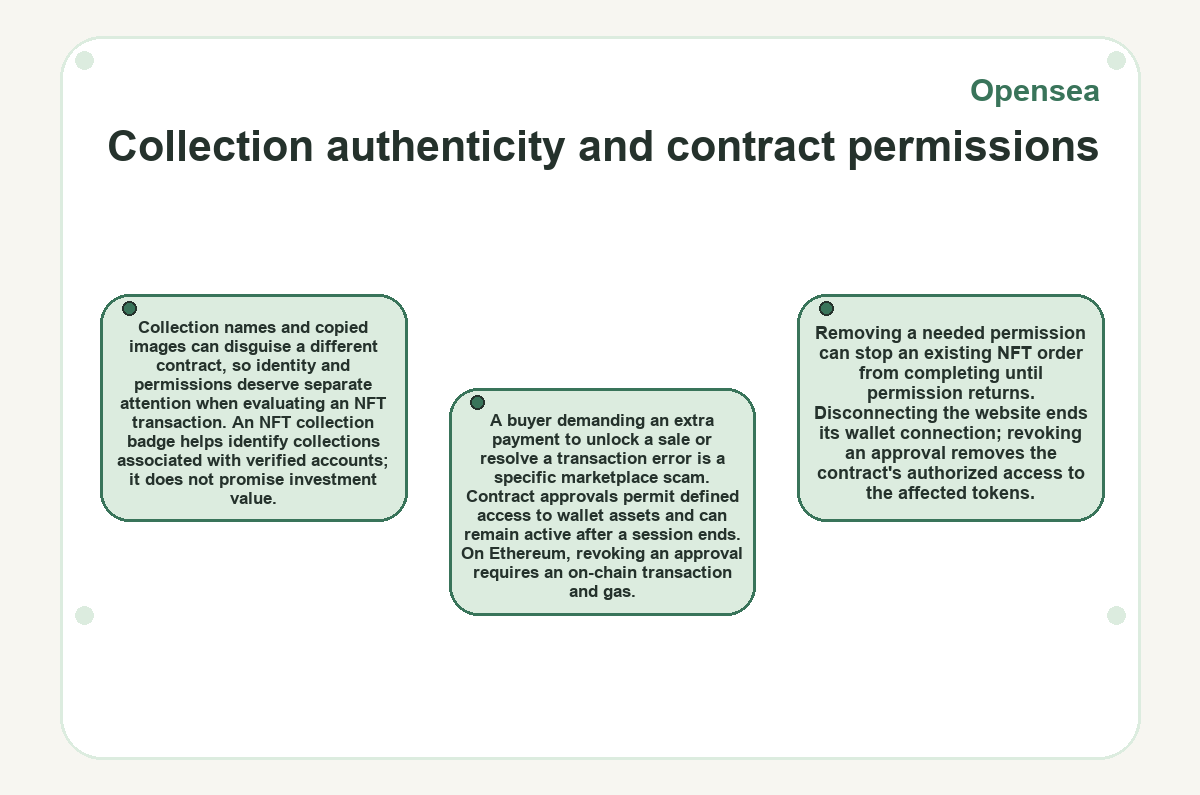
Collection names and copied images can disguise a different contract, so identity and permissions deserve separate attention when evaluating an NFT transaction. An NFT collection badge helps identify collections associated with verified accounts; it does not promise investment value. A buyer demanding an extra payment to unlock a sale or resolve a transaction error is a specific marketplace scam.
Contract approvals permit defined access to wallet assets and can remain active after a session ends. On Ethereum, revoking an approval requires an on-chain transaction and gas. Removing a needed permission can stop an existing NFT order from completing until permission returns. Disconnecting the website ends its wallet connection; revoking an approval removes the contract's authorized access to the affected tokens.
Common questions
Can I update the artwork of an NFT minted in Studio?
Studio allows creators to update media, item names and descriptions for items created through its tools. Saving those edits requires an on-chain transaction and gas. This flexibility does not make every contract field editable: the deployed contract name and token symbol remain fixed. Other collections follow their own contracts and metadata rules.
How long does a drop take to reveal its artwork?
A drop may reveal artwork at minting or on a later date set by its creator. A placeholder can reflect a planned reveal or stale marketplace metadata. Refreshing metadata can update the displayed image after the creator publishes it, but it does not bring a scheduled reveal forward.
What happens to gas when an NFT transaction fails?
A failed on-chain transaction can still consume gas because validators performed computation. That charge does not mean the NFT purchase completed. A wallet rejection before submission differs from a transaction recorded as failed on the blockchain. Opensea does not receive network fees and cannot refund them.
Are bulk purchases of Solana NFTs all-or-nothing?
Bulk purchases of Solana NFTs can complete only partly because each item uses a separate transaction. The selected items must share a blockchain and payment currency. Some purchases can succeed while others fail, and the wallet may request multiple transaction signatures. Receipt of one selected item does not establish completion of the others.
Will an NFT minted through Studio appear on other marketplaces?
An NFT minted through Studio can appear on other marketplaces supporting its blockchain. Minting creates a blockchain asset rather than an item confined to one website's account system. Another marketplace's display and listing support determine how the item appears there. Its original contract and token identity stay the same.
Does Opensea still run Treasure Chest rewards waves?
The Treasure Chest rewards waves ended with Wave 6 on March 30, 2026, with no additional waves planned. Earlier Voyages and chest-level instructions describe that ended program. A past Treasure records previous rewards progress; it does not establish eligibility for a new rewards wave or a reward for a new trade.
Can I move an existing NFT into another Studio collection?
Studio does not allow minted NFTs to move between collections. Its collection groups items under the deployed smart contract. Transferring an NFT to another wallet changes its holder, while retaining its contract identity. Creating a new collection does not relocate items already minted under the earlier contract.
Is a hidden linked wallet private on the blockchain?
Hiding a linked wallet removes its public connection to your Opensea profile, while its blockchain history remains public. The wallet stays linked to your account and remains searchable on the marketplace. This setting controls profile visibility; it does not erase transfers, ownership records or balances from the public network.